Nation
BRICS Summit: Xi’s Delhi visit, Modi-Putin talks put India at centre of shifting global order
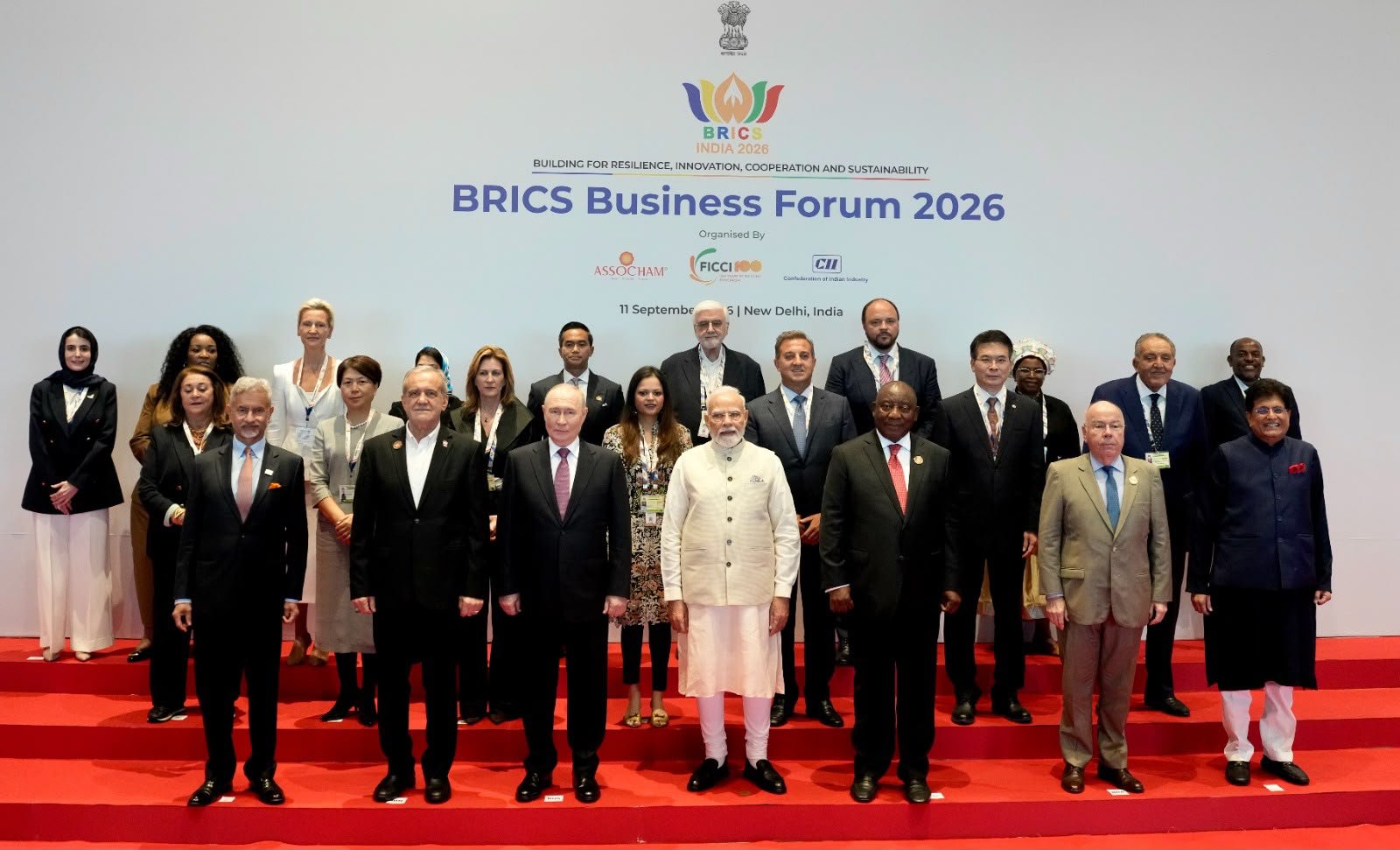
With Xi Jinping’s Delhi visit and Modi-Putin talks taking centre stage, the expanded grouping confronts wars, trade tensions and the challenge of forging a stronger Global South voice
 TDJ News Service
12 Sep, 2026
New Delhi: The 18th BRICS Summit opened in New Delhi on Saturday against a backdrop of wars, trade tensions and growing efforts by emerging economies to reshape the global financial and political order, with Prime Minister Narendra Modi holding talks with Russian President Vladimir Putin and Chinese President Xi Jinping’s arrival in the capital adding a major diplomatic dimension to the two-day gathering.
The summit, being hosted at Bharat Mandapam on September 12 and 13 under India’s 2026 BRICS chairship, brings together an expanded grouping whose agenda stretches from global governance and economic cooperation to energy security, technology, cross-border payments and international conflicts. India has framed its chairship around “Building for Resilience, Innovation, Cooperation and Sustainability”, with the broader vision of “Humanity First”.
The arrival of Xi has emerged as one of the most closely watched developments of the summit. The Chinese President reached New Delhi on Saturday for his first visit to India in seven years and is expected to hold a bilateral meeting with Modi. The engagement comes amid a cautious improvement in India-China relations following the 2020 border clash, while substantial differences remain over the boundary, trade and strategic issues.
The Modi-Xi meeting is significant because the two countries are seeking to consolidate a fragile thaw while continuing to manage substantial differences. India and China have restored direct flights and eased some restrictions since the disengagement process along the Line of Actual Control, but military deployments and territorial disputes remain unresolved. Trade also remains a sensitive issue, with India continuing to run a large deficit with China.
Before the summit, Modi held a 45-minute meeting with Putin in New Delhi, reviewing bilateral cooperation in political, economic, defence, energy, space, mobility and people-to-people ties. The two leaders also discussed closer trade ties and implementation of the Programme for Economic Cooperation 2030. India and Russia have set an ambition of raising bilateral trade to $100 billion by 2030.
The Ukraine war and the wider geopolitical tensions were part of the backdrop to the Modi-Putin engagement. Modi reiterated India's longstanding position that conflicts should be resolved through dialogue and diplomacy. The two sides also discussed the impact of the Ukraine and West Asia conflicts on trade and maritime routes, while India continued to stress the importance of energy security.
West Asia is also casting a long shadow over the summit. Modi held talks with Iranian President Masoud Pezeshkian, stressing freedom of navigation, secure maritime commerce and the safety and welfare of seafarers. The issue carries particular significance for India amid disruptions to shipping and energy flows resulting from the conflict involving Iran.
The economic agenda is equally important. BRICS finance ministers and central bank governors have called for reforms in global development financial institutions, including the IMF and World Bank, arguing that these institutions should become more representative, transparent and accountable to emerging economies. The grouping has also criticised unilateral trade and financial measures and called for closer coordination on cross-border payments.
India is pushing a proposal to link the central bank digital currencies of BRICS countries to make cross-border payments faster and more efficient. The proposal builds on earlier efforts to improve interoperability among BRICS payment systems. However, political and technical obstacles remain, including limited adoption of digital currencies, differences in financial regulations and concerns over deeper financial integration among some member countries. India has stressed that the proposal is aimed at facilitating payments rather than creating a common currency or replacing the US dollar.
The question of BRICS' future financial architecture is part of a larger debate over the bloc's role in the global economy. The grouping now includes Brazil, Russia, India, China, South Africa, Egypt, Ethiopia, Indonesia, Iran, Saudi Arabia and the UAE, although Saudi Arabia's formal position has remained somewhat ambiguous. With its expansion, BRICS represents more than 40 per cent of the world's population and a significant share of global economic output.
Yet the larger BRICS becomes, the harder it may be to achieve consensus. Member states have sharply different foreign-policy priorities, particularly over the wars in Ukraine and West Asia. Questions have also emerged over whether the summit will produce a united declaration, highlighting the difficulty of converting the bloc's growing economic weight into a coherent political position. Indian officials have nevertheless pointed to more than 50 practical outcomes during India's chairship across the areas of resilience, innovation, cooperation and sustainability.
India is also using the summit to showcase its technological capabilities. The Bharat Innovates Exposition at Bharat Mandapam is displaying 37 Indian deep-tech innovations, including AI-based cancer screening, floating solar technology, marine robotics, rare-earth-free electric powertrains and AI-enabled maternal-fetal monitoring. The exhibition is designed to connect Indian startups, universities and research institutions with BRICS investors, companies and other international partners.
For New Delhi, therefore, the summit is more than a diplomatic gathering. It is an opportunity to position India as a bridge between competing global interests — maintaining its strategic partnership with Russia, managing a cautious rapprochement with China, engaging Iran and other Global South countries, while continuing its broader relationships with the United States and Europe.
The immediate test will be whether the expanded BRICS can move beyond declarations and deliver practical cooperation on payments, trade, technology, energy and development finance. For India, the larger objective is to ensure that BRICS evolves not simply into a counterweight to the West, but into a credible platform through which emerging economies can shape the rules of a changing global order.
(The above article has been written with the help AI)
Tags : BRICS, Narendra Modi, Xi Jinping, Vladimir Putin, New Delhi