Delhi
Delhi to build multi-utility underground ducts in Chandni Chowk to curb repeated road digging
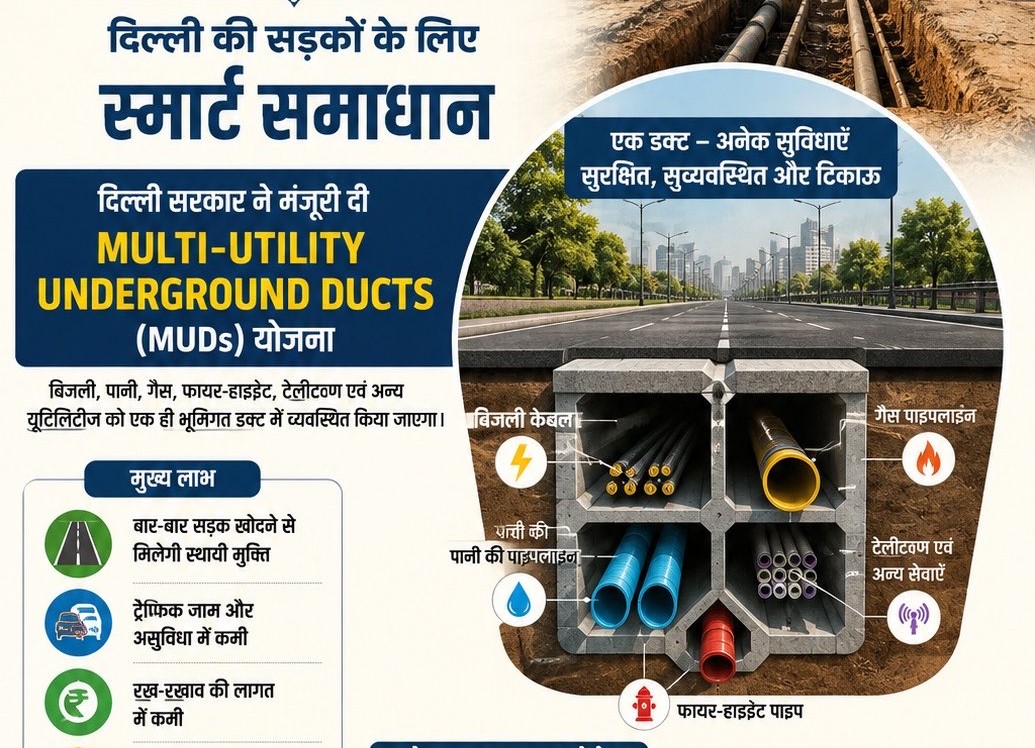
The Delhi government has approved a citywide plan to develop multi-utility underground ducts, beginning with two pilot stretches in Chandni Chowk, in a move aimed at ending the repeated digging of roads for installation and maintenance of essential services
 TDJ News Service
04 Sep, 2026
New Delhi: The Delhi government has approved a citywide plan to develop multi-utility underground ducts, beginning with two pilot stretches in Chandni Chowk, in a move aimed at ending the repeated digging of roads for installation and maintenance of essential services.
According to the Chief Minister’s Office (CMO), as reported by PTI, the pilot will cover 310 metres of Esplanade Road and 560 metres of Mor Sarai Road in Chandni Chowk. Work on both stretches is expected to begin soon.
The proposed ducts will create common underground corridors for multiple utility networks. Wherever technically feasible, they will accommodate electricity cables, water and gas pipelines, fire-hydrant networks and other essential services.
The move seeks to address a longstanding problem in Delhi, where different agencies frequently dig up roads independently to install, repair or expand their respective utility networks. The government said the new system would reduce repeated excavation and subsequent road repairs, while also minimising traffic disruption and inconvenience to residents.
Chief Minister Rekha Gupta said the initiative was part of the government's broader vision of developing safer, better-organised and sustainable urban infrastructure.
“We want to create infrastructure that is safe, well-organised and sustainable, keeping future requirements in mind. The multi-utility duct is part of this vision,” Rekha Gupta said.
An expert technical committee will be constituted to oversee the project and advise on its expansion across the capital. Officials from discoms, the Delhi Jal Board, the Public Works Department and other departments are expected to be part of the committee.
The technical design will incorporate provisions for ventilation, fire safety, maintenance access and emergency response, according to the CMO. The arrangement is also expected to improve coordination between civic and utility agencies and reduce the risk of accidental damage to existing networks during excavation.
The two Chandni Chowk corridors will serve as a test case for the model. After assessing the experience, the government plans to consider constructing similar ducts in other parts of Delhi depending on local requirements.
The choice of Chandni Chowk is significant as the area has already undergone extensive redevelopment, during which overhead electrical cables and other utility infrastructure along the main market stretch were shifted underground.
The concept of shared underground utility corridors is already being used in planned urban developments such as GIFT City in Gujarat. Such systems allow multiple utility networks to be housed within a designated underground space, making future maintenance and expansion possible without repeatedly disturbing the road surface.
The Delhi government's plan, therefore, represents a shift from agency-wise utility work towards a common infrastructure approach, with the Chandni Chowk pilot expected to determine whether the model can be replicated across the capital.
Tags : Delhi government, ducts, chief minister, chandni chowk, rekha gupta