Events & Updates
Firaq’s poetry enriched Urdu with Indian cultural ethos: Scholars
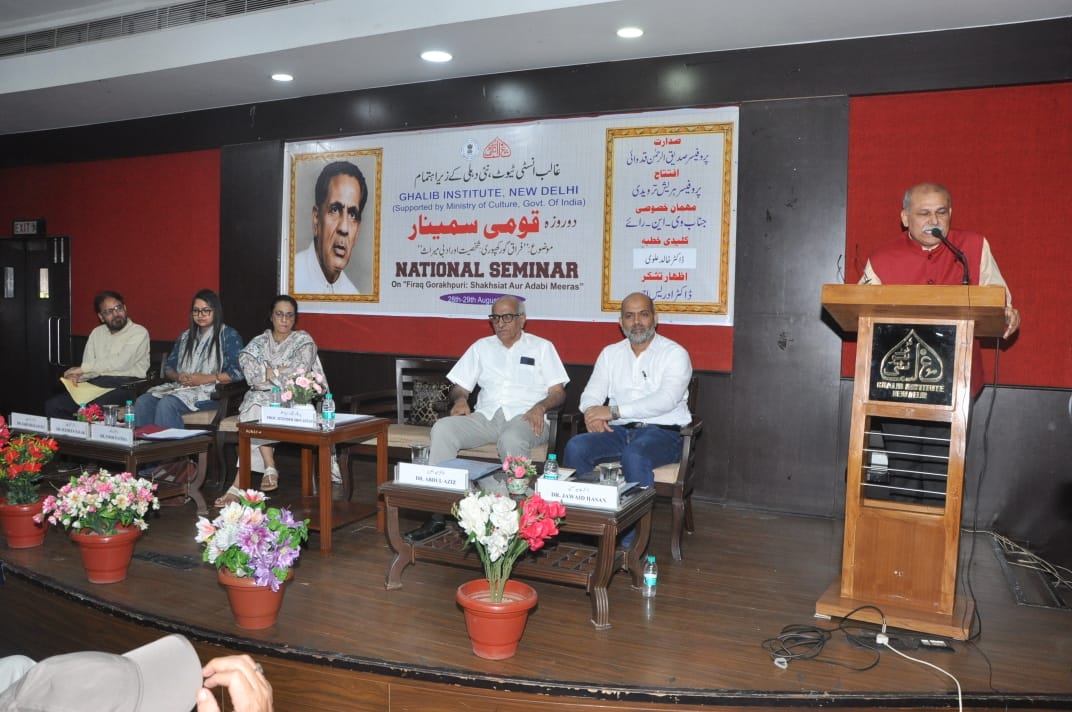
Two-day Ghalib Institute seminar explores poet’s literary legacy, innovative metaphors, prose, criticism and influence on Urdu and Hindi literature
 TDJ News Service
29 Aug, 2026
New Delhi: A two-day national seminar on 'Firaq Gorakhpuri: Personality and Literary Legacy', organised by the Ghalib Institute, concluded with scholars and literary experts discussing the poet’s contribution to Urdu and Hindi literature, his use of Indian cultural elements and his influence on modern poetry.
The seminar featured four technical sessions on October 20, with speakers examining different facets of Firaq Gorakhpuri’s poetry, prose, criticism, correspondence and literary legacy.
The first session, chaired by Professor Shahpar Rasool, former head of the Department of Urdu at Jamia Millia Islamia, focused on Firaq’s contribution to the Urdu poetic tradition. In his presidential address, Rasool said Firaq introduced new dimensions to Urdu poetry, particularly through his innovative use of metaphors.
“Metaphor-making in poetry is a testing stage for a poet, and this aspect is particularly impressive in Firaq’s poetry,” he said, adding that Firaq enriched Urdu poetry with new metaphors.
Professor Khalid Ashraf spoke on 'Firaq and Premchand', while Professor Nadeem Ahmed discussed 'Firaq and Tagore'. Adil Hayat presented a paper on Firaq’s poem writing, Muhammad Adam examined his letter writing, Safina spoke on his rubaiyat and Alia highlighted the distinctive features of his poetry. The session was moderated by Saqib Faridi.
The second session was chaired by Professor Khalid Mahmood, former head of the Department of Urdu at Jamia Millia Islamia. He said Firaq had felt that Urdu poetry, despite its strong Arabic and Persian cultural influences, lacked adequate representation of Indian cultural elements.
According to Mahmood, Firaq addressed this gap by creatively incorporating Indian cultural references into his poetry.
Professor Sagheer Afrahim presented a paper on “The Prose of Firaq: With Special Reference to His Article ‘Ghalib Phir Duniya Mein’”, while Professor Qamarul Huda Faridi spoke on 'The Prose of Firaq as an Impressionist Critic'. Dr Adil Hayat also presented a paper on Firaq’s poetry. The session was moderated by Naushad Manzar.
The third session, chaired by Professor Jitendra Srivastava, examined Firaq’s poetry in the context of time and culture. Srivastava said the significance of poetry should not be judged merely by how much time had passed since it was written, but by how effectively it continues to engage with changing times.
Referring to Kabir, he said a poet’s connection with his culture was not a limitation but a strength, as poetry gains value when it reflects the cultural roots of its society.
Abdul Aziz presented a paper on 'Ghazal Criticism of Firaq', while Noor Fatima spoke on 'Urdu Love Poetry and Firaq'. Sarfaraz Javed examined 'Indian Aesthetics in Ghazals of Firaq', and Seemin Falak discussed 'Shamim Hanafi’s Study of Firaq'. The session was moderated by Javed Hassan.
The fourth and final session was chaired by Professor Abdul Bismillah, who highlighted Firaq’s influence on both Urdu and Hindi poetry. He noted that Firaq had translated 'Amr-e-Jaan Ada' into Hindi and enjoyed considerable popularity among Hindi literary circles.
“Firaq became a symbol of the entire Indian civilisation,” he said, underlining the poet’s role in bridging Urdu and Hindi literary traditions.
Professor Irshad Niazi presented a paper on 'The Style of Firaq', while Moeed Rashidi spoke on 'The Case of Ghazal and Firaq in the Twentieth Century'. Salman Faisal examined 'Indian Woman in Rubaiyat of Firaq', and Imamuddin presented 'A Glimpse of the Remains of Firaq'. The session was moderated by Faisal Khan.
Concluding the seminar, Idrees Ahmed, Director of the Ghalib Institute, thanked the scholars, speakers and participants for their contributions to the discussions on Firaq Gorakhpuri’s enduring literary legacy.
Tags : Firaq Gorakhpuri, Ghalib Institute, Urdu, Hindi, Poet