International
India’s 1-0 Sri Lanka triumph: Dominance in Galle, time lost in Colombo
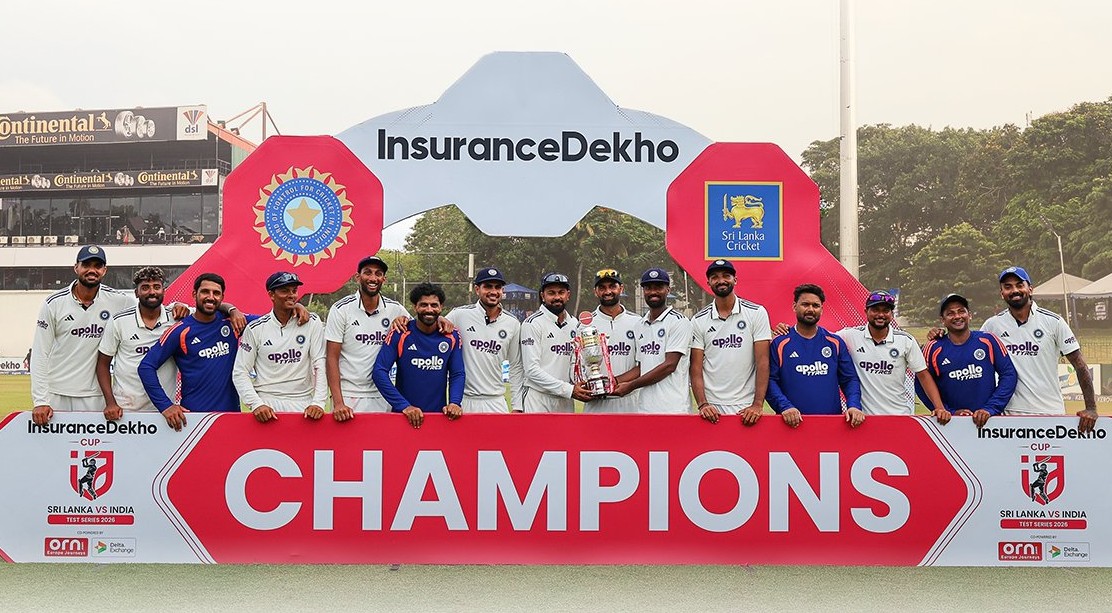
Padikkal and Suthar powered India to a commanding Galle win, but Dinusha’s unbeaten 133 and a stubborn lower order denied them a series sweep in Colombo
 TDJ News Service
01 Sep, 2026
New Delhi: The Indian cricket team returned from Sri Lanka with a 1-0 Test series victory, but the scoreline does not quite capture the contrasting narratives of the two matches. The 165-run win in Galle demonstrated India’s ability to control a Test through superior batting depth and sustained spin pressure. The drawn second Test in Colombo, however, exposed the one thing a dominant side cannot afford to take for granted in Test cricket: the value of time.
India had enough control in Colombo to believe a clean sweep was within reach. Instead, Sonal Dinusha’s extraordinary rearguard, aided by a determined lower order, turned what had looked like a straightforward victory into one of Sri Lanka’s most memorable escapes.
Galle: India’s template for success
The series opener was where India established their superiority. Devdutt Padikkal’s commanding 167 provided the foundation for a first-innings total of 462, while Manav Suthar subsequently emerged as the decisive figure with a 10-wicket match haul. India eventually won by 165 runs after Sri Lanka were dismissed for 284 and 206.
Padikkal’s performance was particularly significant. Coming in at No. 3, he did more than score runs; he gave India stability at the top of the middle order. His ability to bat deep allowed India to build the kind of first-innings advantage that made Suthar’s job possible.
And Suthar was outstanding. His 4/76 in the first innings was followed by 6/55 in the second, giving him 10 wickets in the match. The left-arm spinner was not merely a supporting act on a turning Sri Lankan surface — he was the bowler who repeatedly broke Sri Lanka’s resistance.
The first Test therefore reinforced a familiar Indian strength: bat big, create scoreboard pressure and let the spinners squeeze the opposition out of the game.
Colombo: When dominance was not enough
The second Test initially appeared to be following the same script.
India amassed 503/9 declared, with Padikkal making 117 and Dhruv Jurel producing an impressive 115. Sri Lanka were then bowled out for 290, leaving India with a 213-run first-innings advantage. Shubman Gill's decision to enforce the follow-on was logical: India had an opportunity to finish the series 2-0 and extract maximum WTC value from the match.
But this was where the character of the series changed.
Sri Lanka's second innings was not simply a case of surviving. It became a sustained act of resistance, with Pasindu Sooriyabandara making 92 and Kamindu Mendis 55 before the responsibility increasingly shifted to Dinusha and the lower order.
India kept taking wickets, but never quite found the cluster of dismissals required to break the innings open.
Dinusha’s defining rearguard
At the centre of Sri Lanka’s escape was Dinusha.
He had already scored 103 in the first innings. His unbeaten 133 in the second was therefore his second century of the match and third century of the series. More importantly, this was not a hundred constructed in a conventional run-scoring environment. It was an innings built around judgement, patience and an understanding that every over survived was taking the game away from India.
Dinusha batted for 264 balls and remained unbeaten when Sri Lanka closed on 429/9. The significance of his innings becomes clearer when viewed alongside the situation in which it was played: Sri Lanka had followed on after conceding 213 runs in the first innings and were facing an Indian attack that had already demonstrated its ability to take 20 wickets in Galle.
The most important partnership came with Keshara Nuwantha. The pair survived 31.2 overs in the morning session and added 100 runs, taking Sri Lanka's lead to 116 by lunch. Nuwantha eventually fell for a painstaking 46 from 150 balls, but by then the equation had changed dramatically.
Dinusha then continued the job.
Lahiru Kumara's 12 from 90 balls and Asitha Fernando's unbeaten 0 from 24 deliveries may not look significant in a conventional scorecard, but in the context of the match they were crucial. They deprived India of the wickets they needed while Dinusha remained at the other end.
That was the essence of the rearguard: Sri Lanka did not need to win the Test; it needed to make India run out of time.
India’s missed opportunity
This is where the Colombo draw deserves scrutiny from the Indian perspective.
India had dominated large portions of the series. As Shubman Gill subsequently noted, the team had been in control for much of the contest, and the overall performance was still encouraging.
But Test cricket ultimately rewards the side that completes the job.
India had Sri Lanka 290 all out after scoring 503/9. The follow-on was enforced with a 213-run lead. Yet the Indian attack could not turn that commanding position into victory. By the time Sri Lanka reached 429/9, the hosts had built a 216-run lead and there was no realistic time left for India to chase it.
It would be unfair to describe the result simply as an Indian failure. The Colombo surface and Sri Lanka's batting resistance made the task increasingly difficult. But it was also a reminder that creating a winning position and converting it into a win are two different skills.
India's bowlers had to work through a long second innings, while Dinusha and the lower order made every wicket increasingly expensive.
(This article has been written with the help of AI)
Tags : India, Sri Lanka, Cricket, Manav Suthar, Devdutt Padikkal