Nation
PM Narendra Modi lays out roadmap for developed India by 2047, stresses self-reliance
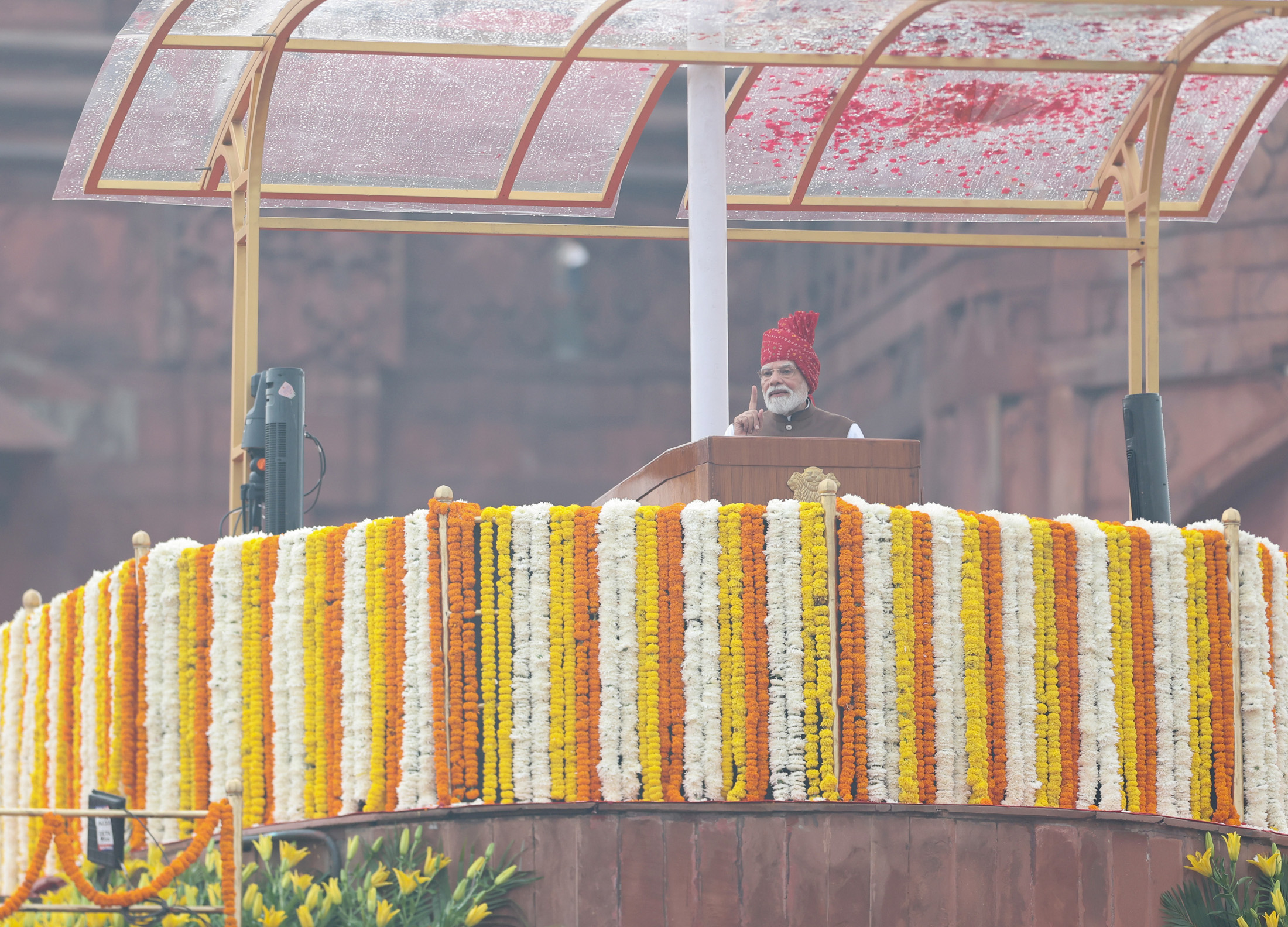
Prime Minister calls for faster reforms, manufacturing, innovation and youth-led growth, urging citizens to turn ambitious national goals into capabilities and results
 TDJ News Service
15 Aug, 2026
New Delhi: Prime Minister Narendra Modi on Saturday laid out an expansive roadmap for building a developed India by 2047, calling for faster reforms, greater self-reliance, manufacturing-led growth, technological innovation and a stronger role for the country's youth.
Addressing the nation from the Red Fort on the 80th Independence Day, Modi said India could no longer afford “small dreams” and urged citizens to match their aspirations with firm resolve and greater capabilities.
“We can no longer move forward with small dreams. We need big dreams because big dreams broaden our thinking and expand the horizons of our thoughts,” he said, stressing that India must set ambitious goals as it moves towards 2047.
The Prime Minister said the central national objective was to transform India into a developed country by the time it completes 100 years of Independence.
“India has also dreamed a very big dream... that when India completes 100 years of independence, in 2047, we will have built a developed India,” he said.
He credited the efforts of citizens across social and economic sections for the country's progress over the past 12 years, saying 250 million Indians had moved out of poverty. He also pointed to India's transition from being counted among the world's “Fragile Five” economies to becoming a major and fast-growing economy.
Modi cited increased production across several sectors as evidence of the change. Defence production, he said, had risen nearly fourfold, khadi and village industries nearly fivefold, electronics manufacturing nearly sevenfold and mobile phone production 35-fold. Modern railway coach production had increased 21-fold.
He also highlighted the expansion of digital infrastructure, saying internet users and consumers had nearly quadrupled, patents granted had increased fourfold and digital transactions had risen 100-fold.
Push for self-reliance
A major theme of the speech was economic and strategic self-reliance. Modi said India must reduce its dependence on other countries and develop domestic capabilities in critical sectors.
“We must become self-reliant,” he said, adding that reliance on easily available imports could weaken the country's own capabilities.
He pointed to semiconductors as a key area. Three semiconductor plants, he said, had already begun operations and production had started being exported.
“In the next seven to eight years, another five, seven or eight semiconductor plants are going to be started very soon,” he announced.
Critical minerals and energy security were identified as other strategic priorities. Modi said India had launched the National Critical Minerals initiative and announced a Critical Minerals Corridor.
On nuclear energy, he set a target of 100 GW of nuclear power by 2047, while saying five new nuclear reactors were being targeted for commissioning during the current decade. He also highlighted India's progress in fast-breeder nuclear technology as a step towards greater self-reliance in nuclear fuel.
The Prime Minister also announced that India was opening up previously restricted offshore areas for exploration. He said ₹85,000 crore had been allocated recently to accelerate the “Samudra Manthan” initiative aimed at exploring the country's maritime resources.
Energy transition and infrastructure
Modi highlighted the expansion of piped gas, solar power and railway electrification as examples of the pace of infrastructure development.
Piped-gas distribution, he said, had expanded from 70 cities before 2014 to 700 cities, while solar energy capacity had risen from two GW to 160 GW.
He said the PM Surya Ghar Muft Bijli Yojana had crossed five million homes with solar installations, allowing some households to reduce their electricity bills to zero and others to earn by selling surplus power.
Railway electrification was cited as another example of accelerated execution. “Ninety years for 30%, 10 years for 70%—this is what work means,” Modi said, referring to the electrification achieved since 2014.
He also highlighted India's entry into hydrogen-powered rail transport, saying the country had started its first hydrogen-powered train.
Seven pillars for growth
The Prime Minister outlined what he called seven “streams of strength” that would drive India's transformation over the next five to seven years: manufacturing, agriculture and food production, technology and innovation, Gati Shakti, defence, the green and blue economies, and India's soft power.
On manufacturing, he called for India to control the entire value chain, from design and components to finished products, and become a trusted hub in global supply chains.
“Our mantra must be: Quality, Quality, Quality,” Modi said, insisting that Indian manufacturers must compete globally on cost, quality and scale.
He said agriculture must move “from the farm to the export market”, with traditional foods, millets, spices, fruits and flowers developed as global brands.
Technology and innovation, he said, would be crucial in an era of artificial intelligence, quantum technology, robotics, space and data centres. India, he added, must not merely become a market for global technology but emerge as an innovation hub.
Modi also set an ambition for India to lead in next-generation communications, including the development and expansion of Made-in-India 6G.
On defence, he said self-reliance was no longer optional. India must develop next-generation defence technologies, drones, counter-drone systems and hypersonic defence capabilities and emerge as a global supplier.
He identified the green and blue economies as major sources of future employment, highlighting green hydrogen, renewable energy, energy storage, green mobility, fisheries, coastal tourism and ocean technology.
India's soft power, he said, could also become a major economic force through yoga, Ayurveda, healthcare, handicrafts, films, VFX, animation, gaming, digital content, tourism and sports.
Youth at the centre
Modi repeatedly placed India's youth at the centre of the 2047 mission. He said more than 250,000 registered startups had emerged under Startup India and announced a Rs 1 lakh crore Innovation Fund.
“I want to tell the young people of the country: bring your dreams to us. We will not allow a shortage of resources to stand in your way,” he said.
He announced that the government would train 10 million young people in AI skills over the coming year, with the objective of enabling Indian youth to lead in the global AI economy.
The Prime Minister also pointed to the growth of India's bioeconomy, which he said had expanded from Rs 60,000 crore before 2014 to Rs 20 lakh crore.
Education and skills were also highlighted, along with the expansion of universities, medical education, Atal Tinkering Labs and new opportunities in space and technology.
Sports, Olympics and talent hunt
Modi said India was strengthening its sporting ecosystem and moving forward with the ambition of hosting the 2036 Olympics and the 2030 Commonwealth Games.
But he also underlined the gap in India's participation across Olympic disciplines. “Out of around 325 events, India does not participate in nearly two-thirds of them,” he said.
He announced a nationwide talent hunt covering villages, cities and schools to identify children aged five to 15 with sporting potential and provide them specialised training.
Security and civil defence
On national security, Modi said India was prepared for changing forms of warfare, including attacks on critical infrastructure such as refineries, banks and data centres.
He said defence exports had increased nearly 50-fold, with Indian weapons and defence equipment reaching around 100 countries.
The Prime Minister announced plans to establish a “vibrant civil-defence network”, including a large voluntary force trained to deal with modern crises.
He also called for continued vigilance against Naxalism and Maoism, while warning against what he termed “Naxalites of the mind”.
Women's participation and social security
Modi called for faster implementation of women's reservation, appealing to political parties to ensure 33% representation for women in state assemblies and the Lok Sabha.
“Come forward as champions of the capabilities of women,” he said.
He also said the government had crossed its target of creating 30 million “Lakhpati Didis” and was now working towards 60 million.
On social security, Modi said coverage had expanded from 250 million people before 2014 to one billion citizens within a decade. He highlighted Ayushman Bharat benefits for senior citizens aged 70 and above and the financial relief provided to families through the scheme.
Call for collective action
Towards the end of his speech, Modi called on citizens, particularly young people, to participate in the Census and provide accurate information digitally, saying reliable data was essential for planning India's future.
Returning to his broader message, he said India's transformation could not be achieved by the government alone.
“The national interest must come above self-interest,” he said, adding that “duty must be our identity.”
He called for the country to turn its aspirations into action and its capabilities into results.
“The time is ours, the opportunity is ours, the resolve is ours,” Modi said.
He concluded with a call for collective effort: “Let us turn dreams into resolutions, resolutions into capabilities, and capabilities into success.”
Modi said India's journey towards 2047 would require the Centre, states, industry, citizens and institutions to work together, with reforms driven not by compulsion but conviction. “Come, together let us build a developed India,” he said.
Tags : PM, Narendra Modi, Speech, Independence Day, Red Fort